
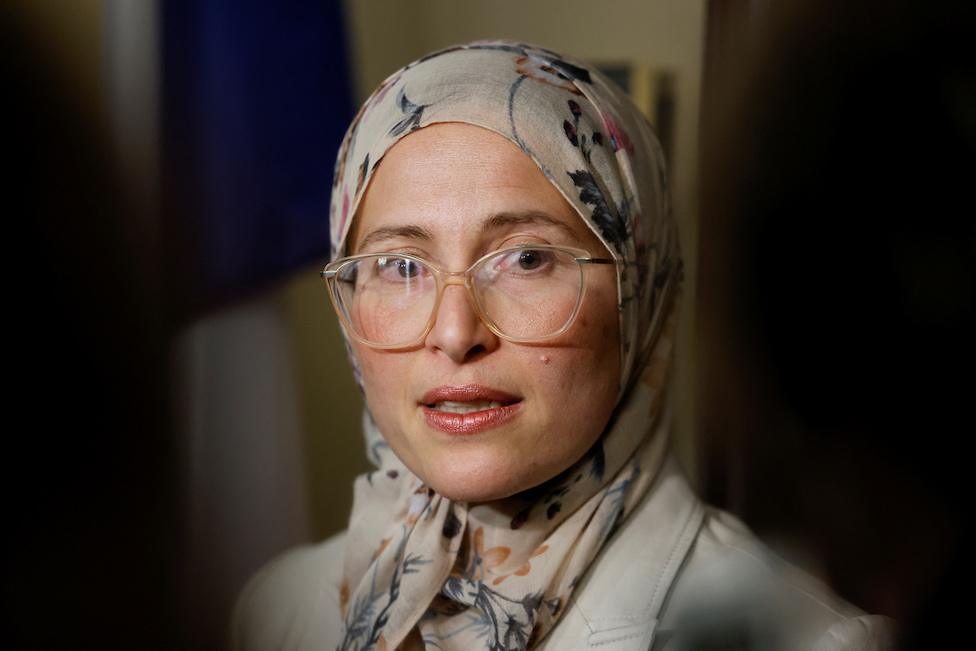
The exchange, captured on video and rapidly circulated across social media platforms, has triggered fierce arguments about free speech, religious criticism, and the responsibilities of universities hosting polarizing intellectual showdowns.
The student, speaking confidently at first, argued that extremist interpretations distort a faith practiced peacefully by millions worldwide who reject violence and cherish coexistence within pluralistic democratic societies globally.
He contended that analyzing sacred texts and legal traditions cannot be dismissed as prejudice, insisting that intellectual honesty requires confronting difficult passages and historical episodes directly rather than reframing them selectively.
The student countered that lived experience matters more than textual literalism, emphasizing community charity, spiritual devotion, and personal morality as defining features of everyday Muslim life across diverse societies worldwide.
Audience members listened in tense silence as Murray cited surveys suggesting support among certain respondents for conservative religious laws, arguing that such data complicates simplified narratives of uniform moderation.
Supporters of Murray described his tone as calm yet relentless, claiming he dismantled what they viewed as vague platitudes by demanding specific answers about doctrine and jurisprudence during the high profile exchange.
Detractors argued the format placed disproportionate pressure on a student facing an experienced debater, questioning whether the encounter resembled genuine dialogue or theatrical confrontation designed for viral consumption.
Video clips show moments where the student paused and appeared emotionally overwhelmed, which some observers interpreted as distress while others described it as frustration amid intense scrutiny before peers.
Social media commentary quickly polarized, with some celebrating the exchange as a victory for open inquiry and others condemning it as an example of aggressive rhetoric targeting a minority faith community.
Religious scholars emphasized that Islam, like Christianity and Judaism, contains diverse interpretive traditions spanning centuries, cautioning against portraying a billion adherents through selective textual citations alone.
Free speech campaigners responded that shielding any religion from scrutiny undermines liberal democratic principles, insisting universities must remain arenas where controversial ideas are rigorously examined without fear.
The incident has revived long running tensions within British academia over platforming speakers accused of Islamophobia versus protecting robust intellectual contestation on sensitive geopolitical subjects.
Murray’s supporters argue he critiques ideology rather than individuals, distinguishing between Islam as a belief system and Muslims as people deserving equal rights and legal protection.
Campus administrators released a measured statement affirming commitment to respectful dialogue while acknowledging that emotionally charged topics require careful moderation to safeguard participant wellbeing.
Student groups organized forums in the aftermath, some inviting Muslim scholars to contextualize theological debates, others planning panels on free expression and the ethics of adversarial discourse.
Political commentators beyond academia seized upon the viral footage, framing it as emblematic of broader cultural clashes between progressive identity politics and critics of religious conservatism in Europe.
Within Muslim communities, reactions varied widely, with some expressing anger at what they saw as caricature while others welcomed theological scrutiny paired with nuanced understanding of diversity.
Meanwhile, secular activists praised the debate’s visibility, arguing that sacred texts and historical narratives should remain open to examination just like any other ideological framework shaping societies.
Experts in conflict resolution cautioned that confrontational debate styles may generate viral moments yet entrench divisions, reducing opportunities for empathetic listening across ideological boundaries.
Others contended that emotional discomfort can signal meaningful engagement, suggesting that challenging conversations are inevitable when deeply held beliefs intersect with modern liberal values.
Murray, for his part, defended the exchange as evidence that universities still permit candid exploration of contentious themes without institutional censorship.
International observers noted parallels with debates in France, Germany, and the United States, where discussions about secularism, integration, and religious pluralism remain politically combustible.
They warned that extrapolating sweeping conclusions from selective findings can obscure ongoing reforms and internal debates within Muslim intellectual circles worldwide.
Nevertheless, the viral framing of the Oxford exchange has crystallized anxieties about whether progressive narratives underestimate tensions between certain traditional doctrines and contemporary liberal norms.
Conversely, critics argue that portraying Islam as uniquely incompatible with modernity ignores similar struggles within other faith traditions adapting to evolving human rights standards.
The debate’s aftermath demonstrates how digital amplification transforms campus conversations into national flashpoints within hours, compressing nuance into shareable clips primed for outrage.
Communications scholars describe this phenomenon as performative polarization, where participants become symbols in broader cultural battles transcending the original academic context.
In Britain’s multicultural landscape, such moments resonate deeply because they touch on identity, belonging, and the fragile balance between security concerns and civil liberties.
Some policymakers caution that sensationalized exchanges risk overshadowing collaborative initiatives addressing poverty, education, and interfaith understanding across diverse communities.
Yet advocates of uncompromising critique maintain that confronting uncomfortable historical episodes, including military campaigns and legal codes, is essential for intellectual integrity.
Historians remind audiences that all major religions contain complex legacies involving both spiritual inspiration and political entanglement, urging comparative perspective rather than isolated condemnation.
The Oxford event thus becomes a microcosm of global discourse, where questions about scripture, law, and modern values intersect with emotions, identities, and media incentives.
Whether one interprets the student’s reaction as vulnerability under pressure or evidence of rhetorical defeat depends largely on prior assumptions about Islam and secular critique.

What remains indisputable is that the footage has sparked widespread conversation about how societies negotiate respect for believers while preserving the right to interrogate beliefs rigorously.
In the days ahead, universities across Britain may reevaluate debate formats, ensuring that intellectual challenge does not devolve into personal humiliation before audiences hungry for spectacle.
At the same time, advocates of open discourse will likely resist any reforms perceived as diluting the intensity that makes such exchanges compelling and culturally influential.
The Oxford confrontation ultimately underscores a defining tension of contemporary democracies: balancing fearless inquiry with social responsibility in increasingly pluralistic societies.
As Britain continues grappling with integration, identity, and freedom, moments like this serve as catalysts forcing citizens to articulate where they draw lines between critique and condemnation.
Whether viewed as triumph for free speech or troubling display of rhetorical imbalance, the debate has ensured that questions about Islam’s interpretation and representation remain firmly in public consciousness.

The challenge now lies in channeling the surge of attention toward informed dialogue rather than reactive hostility, preserving both intellectual courage and communal cohesion
