
“I Seem to Have Cried My Whole Life”: Caroline Kennedy and the Silent Grief at Her Daughter’s Funeral

Grief does not always announce itself with sobs.
Sometimes, it appears in silence—in the rigid set of a jaw, the careful stillness of a woman who has spent a lifetime learning how to endure sorrow in public. On a gray, hushed morning, as mourners gathered to say farewell to Tatiana Schlossberg, it was not tears that defined Caroline Kennedy’s presence, but restraint.
She did not weep openly. She did not collapse. She stood composed, dignified, almost immovable.
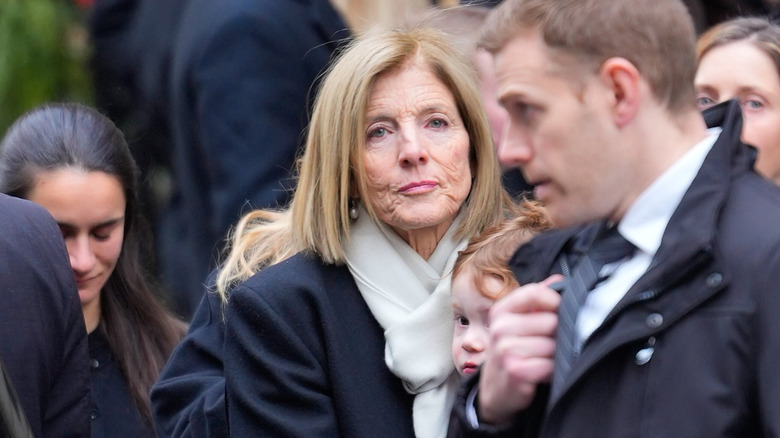
A photograph—captured unintentionally by an onlooker—froze a private gesture into permanence: Caroline Kennedy turning slightly away from the crowd, lifting her hand to her face, discreetly wiping away tears she believed no one would see. It was not a dramatic breakdown. It was something far more devastating: a mother’s instinctive attempt to grieve without burdening the world with her pain.
Later, a single sentence attributed to her would echo with quiet force:
“I seem to have cried my whole life.”
In that moment, the words felt less like a quote and more like a confession—one that stretched across generations of loss, public tragedy, and a family forever entwined with America’s collective memory of grief.
A Lifetime Lived Under Watchful Eyes
To understand the weight of that moment, one must understand Caroline Kennedy’s life—not as a political figure or cultural icon, but as a child who learned too early that grief, once public, never truly belongs to the grieving.
She was five years old when her father, President John F. Kennedy, was assassinated in Dallas. The image of a young Caroline standing beside her mother, Jacqueline Kennedy, during the funeral became one of the most enduring symbols of national mourning. It was the first time America saw her cry—but it would not be the last time America would expect her to remain composed.
In the decades that followed, Caroline Kennedy became synonymous with grace under pressure. She learned how to carry sorrow with poise, how to navigate tragedy without allowing it to define her entirely. The deaths of her uncle Robert F. Kennedy, her brother John F. Kennedy Jr., and other family members formed a painful pattern—each loss adding another layer to a grief she never fully expressed aloud.
Public expectation shaped her response. She became the woman who did not break.
But that does not mean she did not feel.
The Loss of a Daughter
Tatiana Schlossberg was not just Caroline Kennedy’s daughter; she was her continuation, her hope, her future refracted through a new generation. Intelligent, private, and thoughtful, Tatiana largely avoided the glare that followed the Kennedy name. She built her own identity quietly, away from spectacle, choosing substance over celebrity.
Those who knew her described her as reflective, deeply empathetic, and grounded—traits many say mirrored her mother’s quieter strengths.
The circumstances surrounding Tatiana’s death were met with restraint from the family, a deliberate decision to preserve dignity and privacy. No dramatic statements were issued. No press conferences held. Instead, there was silence—a silence heavy with love, disbelief, and a grief too profound for public explanation.
At the funeral, that silence became visible.
Caroline Kennedy stood among mourners as a mother who had already buried too many loved ones, now facing the unthinkable: the loss of her child.
Strength as Performance
For much of the service, Caroline Kennedy appeared composed. Her posture was straight. Her expression neutral. To some, it might have seemed as though she was holding herself together remarkably well.
But those who understand grief know better.
Strength, especially in public figures, is often a performance learned through repetition. It is the ability to compartmentalize pain long enough to fulfill expectations. Caroline Kennedy has practiced this her entire life.
She knows when cameras are present.
She knows how history watches.
She knows what people expect a Kennedy to look like in mourning.
And so she complied—until she couldn’t.
The photograph captured a moment in between breaths, in between roles. She turned her face away, as if instinctively protecting her vulnerability. Her hand moved quickly, almost apologetically, to wipe away tears she did not intend to share.
It was a human reflex, not a statement.
And that is precisely why it resonated so deeply.
“I Seem to Have Cried My Whole Life”
The sentence, spoken quietly, carries the weight of a lifetime.
It is not theatrical.
It is not self-pitying.
It is weary.
“I seem to have cried my whole life” is not merely about the loss of a daughter. It is about cumulative grief—the kind that does not reset after each tragedy but compounds, settles into the bones, and changes the way a person experiences the world.
For Caroline Kennedy, tears are not a response to a single moment. They are part of a continuum stretching back to childhood, shaped by national trauma and personal devastation.
She cried as a child standing beside her mother in a black veil.
She cried as a sister burying her brother.
She cried as a daughter mourning a father the world still mythologizes.
And now, she cried as a mother burying her child.
There is no preparation for that kind of loss—no amount of experience that makes it easier.
The Private Cost of Public Grace
The Kennedy family has long been admired for its ability to face tragedy with elegance. But elegance often comes at a cost.
For Caroline Kennedy, that cost has been the suppression of visible grief. The unspoken understanding that her pain is never solely her own—that it belongs, in part, to the public.
And yet, the image of her wiping away tears pierced through decades of carefully maintained distance. It reminded the world that behind the surname is a woman who has lost too much, too often.
Grief does not diminish with familiarity. It deepens.
And motherhood, once marked by joy and continuity, became the source of her most devastating heartbreak.
A Moment That Changed the Narrative
The photograph circulated quietly at first. There was no sensational headline. No dramatic framing. But those who saw it understood its power immediately.
It was not about scandal or spectacle.
It was about recognition.
Recognition that strength can coexist with fragility.
Recognition that even those who appear unbreakable still break—just briefly, just privately.
Recognition that grief does not need to be loud to be real.
In that single moment, Caroline Kennedy was no longer an emblem of endurance. She was simply a mother, overwhelmed by the finality of loss.
When Silence Speaks Loudest
Caroline Kennedy did not address the crowd with words of farewell. She did not issue a public eulogy filled with quotations or reflections.
Instead, she allowed silence to speak.
And in that silence—punctuated by a furtive gesture and a single haunting sentence—the world witnessed something rare: unfiltered grief from someone who has spent her entire life shielding it.
“I seem to have cried my whole life.”
It is a line that will linger, not because it was spoken loudly, but because it was true.
True in its exhaustion.
True in its honesty.
True in its quiet devastation.
The Enduring Image
Long after the service ended, long after the mourners dispersed, the image remains.
A woman turning away.
A hand lifted.
A tear wiped before it could fall.
Not because she was ashamed to cry—but because she has learned, painfully, how little space the world gives her to do so.
In that fleeting moment, Caroline Kennedy reminded us that grief is not measured by how visibly it is expressed, but by how deeply it is carried.
And some people, it seems, have been carrying it their entire lives.
